
All states & Federal Bridge Law
Michigan Bridge Laws
MI
The Federal Bridge Law and Federal Bridge Formula apply to all interstate and federal highways across the nation, and many states have adopted them state-wide.
Quick Summary / Synopsis for Dump Trucks
So in theory, a Quint with 3 auxiliary axles could weigh up to 89,000 lbs. However, in reality it isn’t possible for a typical straight dump truck like a Quint to distribute enough weight to the forward axles for this to be possible (the tandem drive axles would inevitably greatly exceed the 32k limit, while the steer axle and forward pusher axle would be under-loaded), and so a typical Quint wouldn’t be able to weigh over 64,000 lbs due to those axle limits and weight distribution. This is why combination trailers (pup trailers and transfer trailers) are so popular in Michigan.
Michigan Truck Operator Map (with Vehicle Weight Limits)
Note: The weight limits stated here don’t account for the seasonal restrictions. The link above shows the breakdown of the vehicle weight limits in MI with the seasonal restrictions, as well as the designated highways (the green and gold roads) where vehicles are allowed 102″ in width (96″ width limit on non-designated highways).
Recommendations
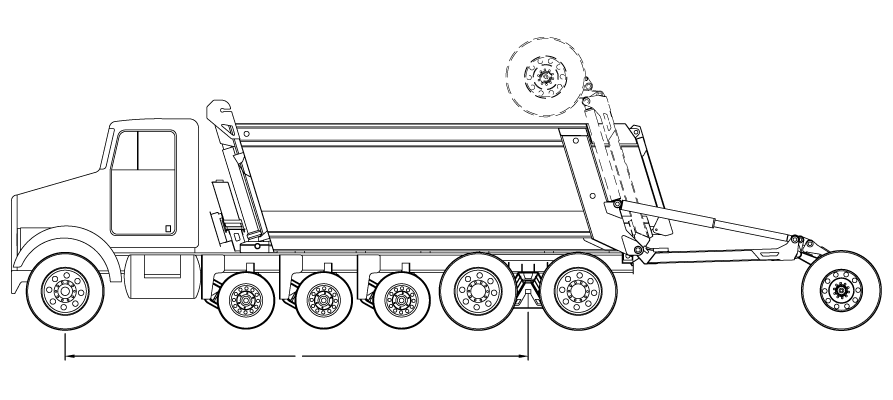
One unique characteristic of the Super Dump is how the Strong Arm trailing axle distributes significant weight from the tandem drive axles to the front axle(s). With this weight re-distribution capability, and 13k to 14k lbs on the trailing axle, a 7-axle Super Dump can (legally and practically) weigh up to 95,000 lbs in Michigan – which would mean payloads of 32 Tons.
When you account for turnaround time — all the extra time spent in transit and at the dump sites with pups and transfers — Super Dumps will typically be able to make 50% more trips in a work day.
So if a pup/transfer/train can make 4 trips hauling 44 tons each trip, it would haul 176 tons that day. While a Super Dump would make 6 trips hauling 32 tons each trip, which would be 192 tons hauled that day.
Vehicle Size Limits
Examples for Michigan
Legacy data last updated: 10/11/2018
Disclaimer
This page is intended as a general informational reference for dump truck weight laws. Weight laws can be complicated and may change. Special permits, grandfather rights, seasonal restrictions, road classes, and local rules may apply. Always verify with the applicable DOT or state authority before relying on any weight-law information.